
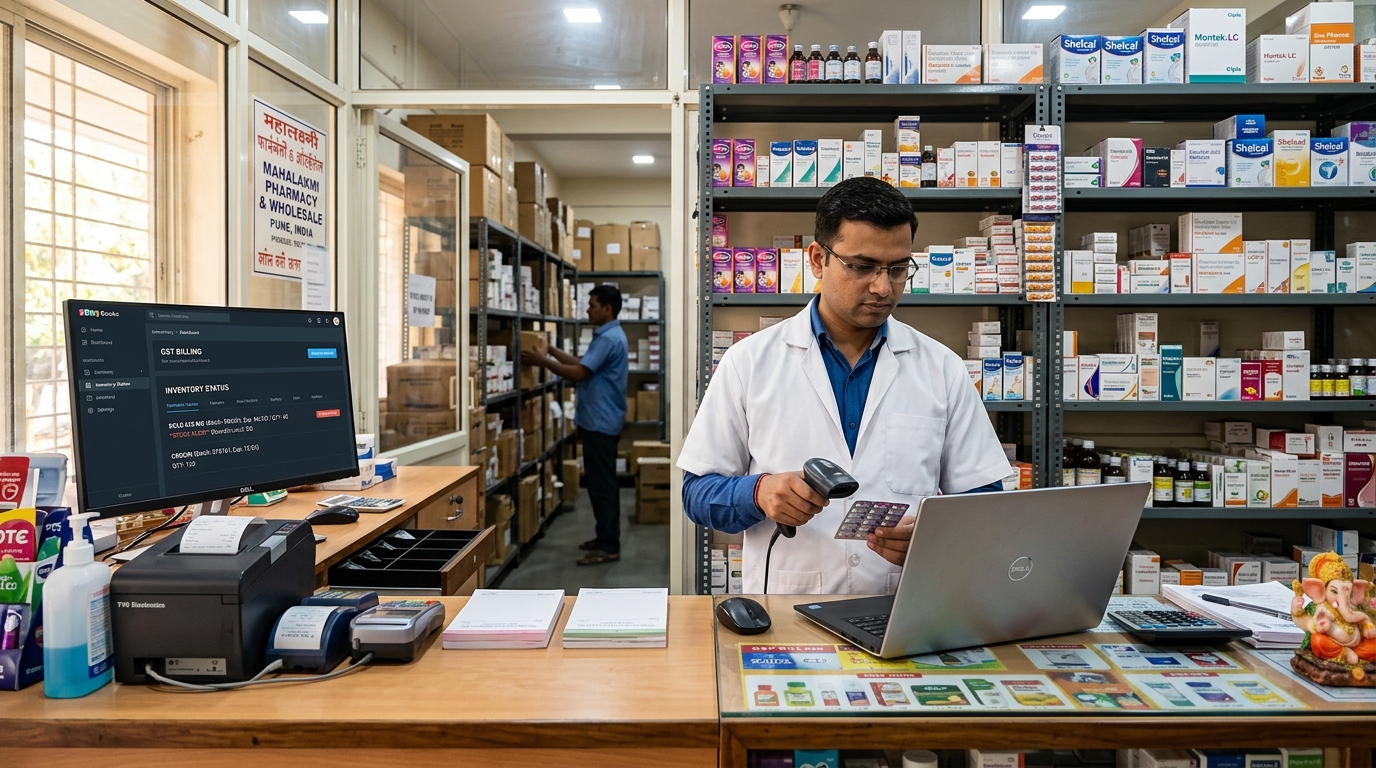
Indian pharma wholesale distribution is not simple box-shifting—it is a high-volume, low-margin (8% to 10% gross PTS) game where silent operational leakages destroy annual profitability. Between 400+ morning WhatsApp chemist orders, complex deal schemes (10+1, 20+3 half-schemes), chemist payment delays crossing 45 days, and unresolved expiry/breakage claims stuck with company depots, stockists lose 2% to 4% of their net margins every year. Discover how modern cloud-based pharma distribution software stops claim leakages, enforces strict chemist credit limits, automates route-wise tempo delivery, and delivers instant 1-click E-Invoicing and E-Way bill compliance.
It is 8:30 AM in the bustling medicine wholesale market—whether you are operating out of Bhagirath Palace in Old Delhi, Aminabad in Lucknow, Dawa Bazar in Indore, Princess Street in Mumbai, or Govind Mitra Road in Patna.
Your WhatsApp is buzzing uncontrollably with 350+ blurry photos of handwritten kachha parchis, audio voice notes from retail chemists, and field salesman bookings (POBs). Outside, four delivery tempos and three bike riders are waiting for morning route crates. Inside the godown, four packing boys are shouting across aisles to locate specific batches of Augmentin 625, Pantocid DSR, and Monocef 1g.
Meanwhile, your senior billing operator is staring at a frozen, 15-year-old desktop software screen because the LAN cable slipped or a multi-user indexing error crashed the local database.
If this morning chaos sounds painfully familiar, you are not alone. Operating a pharmacy wholesale and stockist agency in India is one of the most operationally demanding businesses in the world. You are balancing strict FDA statutory compliances (Form 20B/21B Wholesale Drug Licenses, Schedule H1 registers), paper-thin margins, demanding pharmaceutical manufacturing companies (Cipla, Sun Pharma, Mankind, Abbott, Torrent, Alkem), and hundreds of retail chemists who constantly stretch credit lines.
The Real Dilemma of Indian Medicine Stockists:
- Topline looks impressive: Monthly turnover is ₹50 Lakhs, ₹1.5 Crores, or ₹5 Crores.
- Bottomline is tight: Gross stockist margins are capped at 8% to 10% (PTS), while operating expenses (godown rent, delivery fuel, packing staff, power, interest on bank OD) consume 5% to 6%.
- Net margin is just 2% to 3%: If even a fraction of your company claims bounce or two large chemist shops default on payments, your entire monthly net profit is wiped out.
The 5 Silent Margin Leaks That Bleed Indian Pharma Wholesalers
Most wholesale business owners believe their biggest headache is competition from other stockists offering extra cash discounts (CD). But when you audit the balance sheets of 200+ Indian medicine distributors, the real margin destruction comes from five hidden operational leaks inside their own office.
1. The 3-Way Expiry & Breakage Claim Trap (Where 2% Profit Disappears)
Every week, retail chemists return cartons of expired syrups, damaged ampoules, and unsold near-expiry strips back to your godown. Your staff accepts them, scribbles a rough entry on a slip, and dumps the cartons in a corner of your "Quarantine/Damage Godown."
Here is where the financial disaster unfolds:
- Chemist insists on instant credit: The retail chemist demands a Credit Note (CN) immediately at current PTR or purchase PTS to settle their monthly payment.
- Stock sits unfiled for 90 days: Because sorting 3,000 mixed strips across 35 different pharma companies is tedious, claims sit in the corner until company return deadlines expire.
- Company Depots reject 15%–25% of claims: When your claim finally reaches the C&F Depot of Cipla, Mankind, or Sun Pharma, their audit team slashes line items due to:
- Batch mismatch (chemist bought batch X from another distributor, but returned it to you).
- Claim submission window breached (many MNCs mandate expiry return within 60 days of expiry).
- Scrap value deductions and "Rate Difference" penalties.
- Unadjusted Claim Discrepancies: You credited the chemist ₹1,00,000, but the pharma company only issued a Credit Note of ₹78,000. Who absorbs the ₹22,000 loss? You do. Multiplied across 12 months, this silent leak costs stockists ₹3 Lakhs to ₹15 Lakhs every single year.
2. The Deal Scheme & Half-Scheme Calculation Confusion
Pharma marketing runs entirely on commercial trade schemes:
- Deal Schemes: 10+1 free, 10+2 free, 20+3 free, 100+15 free.
- Half-Schemes: A chemist only needs 5 boxes instead of 10. The market convention dictates giving them an equivalent cash/trade discount (e.g., 4.76% or 9.09% discount in lieu of the free box).
- Section 15(3) CGST Act Compliance: Under GST laws, post-sale cash discounts are only deductible from taxable turnover if they are linked to pre-agreed invoices and the buyer reverses input tax credit (ITC). If your billing software miscalculates GST on free goods or mixes up taxable value with trade discounts, you face severe GST scrutiny during audit.
During the 9:00 AM billing rush, when an operator enters 80 bills an hour, manual scheme selection leads to rampant mistakes—applying 10+2 on a brand that only offered 10+1, or missing company QPS (Quantity Price Schemes).
3. The 21-Day Chemist Credit Trap & Rogue Billing
In theory, Indian pharma wholesale operates on a 21-day or 30-day payment cycle. In reality:
- Chemists pay on a "rotating bill" basis—clearing their oldest bill while taking two fresh bills on credit.
- Before you know it, an account with a ₹1,00,000 credit limit is sitting at ₹3,20,000 outstanding across 75 days.
- When the credit limit is breached, the chemist calls the counter boy or billing clerk, gives an emotional excuse ("Sir, my mother was hospitalized, bill this order, cheque is clearing on Monday"), and the operator manually overrides the lock.
- When that chemist shop eventually shuts down or changes partners, recovering the ₹3.2 Lakhs becomes an endless court battle.
4. DPCO & Company Rate Revision Losses
When the National Pharmaceutical Pricing Authority (NPPA) enforces DPCO ceiling price revisions, or a company slashes PTR/PTS mid-quarter, distributors are left holding godown inventory purchased at the older, higher price.
To recover this difference, the distributor must generate a Rate Difference Debit Note backed by exact batch numbers, purchase invoice dates, and physical closing stock counts on the date of price change. Without automated batch tracking, stockists fail to file timely rate revision claims and surrender thousands of rupees to the manufacturer.
5. Delivery Tempo Dispatch Mix-Ups & Missing Route Cash
If you run 3 delivery routes servicing 150 chemist counters daily:
- Packing boys pack boxes without a consolidated route picking sheet. Crates get switched between Chemist A and Chemist B on the same street.
- Delivery boys collect cash from 25 counters, hand over the cash in a crumpled bag in the evening, and discrepancy reconciliation takes 2 hours of counter fighting.
- Chemist claims: "Bhaiya, I returned 2 boxes of Calpol 650 with your delivery boy last Tuesday," but there is zero physical paper or digital receipt confirming who took it.
The Complete Expiry Claim Reconciliation Architecture
How should a professional pharmaceutical wholesale ERP solve the expiry-breakage nightmare? Here is the exact 6-step closed-loop reconciliation process used by top-tier Indian medicine distributors:
The Real Math of Pharma Wholesale: MRP, PTR, PTS, Schemes & GST
To understand why generic billing software fails in pharma wholesale, you have to look at the unique pricing structure governed by the Drug Price Control Order (DPCO) and pharmaceutical trade traditions in India.
| Pricing Component | Standard Industry Formula | Example: Amoxy-Clav 625mg (10 Tabs) | Who Gets What? |
|---|---|---|---|
| Maximum Retail Price (MRP) | Inclusive of all taxes (printed on pack) | ₹220.00 | Patient / End Customer pays this at retail chemist counter |
| Price to Retailer (PTR) | (MRP - GST Component) ÷ 1.20 (gives 20% margin to retailer on base) | ₹163.64 (Base PTR excluding 12% GST) | The price at which the wholesaler invoices the retail chemist |
| Price to Stockist (PTS) | PTR ÷ 1.10 (gives 10% gross margin to stockist on base) | ₹148.76 (Base PTS excluding 12% GST) | The price at which the manufacturing company bills the stockist |
| Deal Scheme (e.g. 10 + 1 Free) | 1 free strip for every 10 strips purchased (9.09% volume bonus) | Cost per strip drops to: ₹135.24 | Shared between manufacturer, stockist, and chemist |
| Trade Discount (TD) | Additional commercial incentive (typically 1.5% to 3%) | 2% on Base = -₹2.97 per strip | Passed on bill to build retailer loyalty |
| Cash Discount (CD) | Prompt payment discount (1% to 2% within 7 days) | 1.5% off final taxable amount | Incentive for chemist to pay before 21-day credit cycle |
| Applicable GST Rate | 5% (life-saving) or 12% (standard allopathic) or 18% (nutraceuticals) | 12% GST (CGST 6% + SGST 6%) | Fully adjustable via Input Tax Credit (ITC) on GSTR-2B |
Notice the complexity: If your billing operator makes a simple mistake—such as calculating Cash Discount on MRP instead of taxable PTR, or failing to account for the GST liability on the free strip under Section 15(3)—your thin 8% margin is completely wiped out.
The Operational Blueprint: 6 Capabilities Every Pharma Stockist Needs in 2026
If you are evaluating modern pharma wholesale software or upgrading from an outdated desktop system, ensure your software delivers these six non-negotiable operational capabilities:
In retail, FIFO (First In First Out) might pass. In pharma wholesale, FEFO (First Expiry First Out) is non-negotiable. When an order for 200 boxes of Azithromycin 500mg comes in, the software must instantly allocate the earliest expiring batches across the warehouse. More importantly, it must feature a Near-Expiry Quarantine Lock: automatically preventing batches with less than 6 months shelf life from being billed to regular chemists unless specifically tagged for a clearance scheme.
No more counter staff quietly overriding credit limits because a chemist promised to pay tomorrow. The system must enforce:
- Credit Amount Cap: Max ₹1.5 Lakhs balance allowed.
- Aging Cap: No unpaid bills older than 30 days.
- Cheque Bounce Lock: Instant automatic billing freeze if any PDC or bank cheque bounces.
- Proprietor OTP Override: If a trusted chemist genuinely needs emergency stock, an override requires a 6-digit OTP sent straight to the business owner's mobile.
Instead of billing 60 individual orders and having packing boys run back and forth through aisles 60 times, the ERP generates a Single Consolidated Master Picking Slip for Route #1 (e.g., Civil Lines to Cantt). The godown team picks 250 total items in one pass, distributes them into color-coded chemist crates, and prints a Delivery Boy Trip Sheet that tracks cash/cheque collection with digital customer signatures upon delivery.
Selling allopathic medicines to a retailer whose Drug License (Form 20 or Form 21) has expired is a criminal offense under Section 18(c) of the Drugs and Cosmetics Act, 1940. It risks immediate suspension of your own wholesale license. UdyogBill tracks every retail chemist’s DL renewal date and GSTIN status, issuing warnings at 30 days and freezing billing the moment the license expires.
For wholesale stockists with turnover exceeding ₹5 Crores, generating B2B E-Invoices with real-time IRN and QR codes is mandatory. Furthermore, any consignment valued over ₹50,000 requires an E-Way bill. Doing this manually on government portals takes 10 minutes per bill. Modern pharma ERP connects directly to the IRP portal via API, generating the signed QR code and E-Way Bill Number directly on the printed delivery invoice in under 2 seconds.
Your field salesmen (MRs or order-booking boys) visit 25 chemist shops a day. Why should they write orders on paper or send messy WhatsApp text messages that need manual data entry at night? With UdyogBill’s mobile app, salesmen see live godown stock availability, active company schemes, and the chemist’s current outstanding balance. Orders booked on the road reflect instantly in the office billing queue.
Traditional Desktop Software (Marg/Tally) vs Modern Cloud Pharma ERP (UdyogBill)
For over twenty years, the Indian pharma wholesale market was dominated by legacy desktop tools. While they served the market well during the VAT and early GST eras, their outdated architecture is now choking modern, multi-brand wholesale growth.
| Feature / Capability | Legacy Desktop Software (Marg ERP / Tally) | Modern Cloud Platform (UdyogBill Pharma ERP) |
|---|---|---|
| Architecture & Data Safety | Local Windows PC storage. Highly vulnerable to hard drive crash, ransomware viruses, and file indexing (.dbf / .dat) corruption. | Enterprise Cloud (PostgreSQL on NVMe SSD). Automated daily backups, zero risk of virus/ransomware, 99.99% uptime. |
| Remote Business Control | Tied to your shop counter. If you are traveling, at a pharma convention, or at home, you cannot view live sales or cash. | Access from Anywhere. Check live sales, godown stock, and cash counter balance on your mobile phone or laptop in real-time. |
| Multi-User Peak Performance | LAN slows to a crawl or crashes when 4 billing operators and 2 packing counters access the database simultaneously. | High-Speed Concurrent WebSockets. Handles 50+ operators, sales reps, and dispatch staff simultaneously without a millisecond lag. |
| Chemist WhatsApp Ledgers & Invoices | Requires external third-party DLL plugins, manual PDF export, or paid SMS packs with high failure rates. | Native WhatsApp Business Integration. 1-click automatic dispatch of beautiful A4 GST Invoices, payment receipts, and monthly ledger statements. |
| Expiry Claim Reconciliation | Manual debit note entry. Zero automated linking between chemist returns and manufacturing depot claims. | Automated 3-Way Reconciliation Engine. Pinpoints claim differences, prevents unauthorized returns, and tracks depot credit notes. |
| Hardware & Licensing Costs | Expensive multi-user LAN licenses, annual AMC charges, dedicated server PC requirements, and costly on-site engineer visits. | Transparent Affordable Subscription. Runs on any basic laptop, tablet, or smartphone. Free automatic software updates forever. |
Step-by-Step: How to Migrate Your Wholesale Business in Under 2 Hours
The biggest fear holding back medicine distributors from upgrading is: "I have 45,000 medicine items and 800 chemist balances in my old Marg/Tally system. If migration takes 3 days, my business will shut down!"
With UdyogBill, migration is engineered to happen seamlessly after shop closing hours without interrupting a single morning dispatch:
-
1
Step 1: One-Click Master Excel Export
Export your Item Master (Product Name, Company/Manufacturer, Packing, Salt, HSN, Tax Slab, MRP, PTR, PTS) and Party Master (Chemist Name, Address, Drug License 20B/21B, GSTIN, Opening Balance) from your existing software. -
2
Step 2: AI-Powered Smart Data Cleaner
Upload your Excel files into UdyogBill. Our automated schema mapper validates HSN codes, removes duplicate items, checks GSTIN validity against the GSTN database, and maps active batch numbers. -
3
Step 3: Physical Godown Stock Cutoff
Close your evening billing at 9:00 PM. Enter physical batch counts or import your closing stock statement. Your opening inventory with exact batch-wise expiry dates is loaded in 15 minutes. -
4
Step 4: Go Live at 8:30 AM Next Morning!
Your operators log in via browser or desktop app. Barcode thermal printers, laser invoice printers, and delivery van sheets are ready to roll immediately.
Stop Losing Money to Expiry Claims & Chemist Overdues
Join hundreds of progressive medicine stockists and distributors across India who have switched to UdyogBill Pharma ERP. Protect your margins, automate E-Invoicing, and take full control of your wholesale empire.
✓ Zero Setup Fee • Free Marg / Tally Data Migration • Dedicated Onboarding Specialist
Frequently Asked Questions (FAQs) by Indian Pharma Wholesalers
In 2026 and beyond, running a pharma wholesale distribution agency on 20-year-old desktop software is like driving a bullock cart on an express highway. Pharmaceutical companies are demanding real-time sales visibility, retail chemists expect instant WhatsApp invoices, and tax authorities require seamless E-Invoicing. By eliminating expiry claim leakages, enforcing ironclad credit limits, and streamlining route dispatches, UdyogBill Pharma ERP doesn't just save you time—it directly adds 2% to 3% back to your net bottom-line profit.